
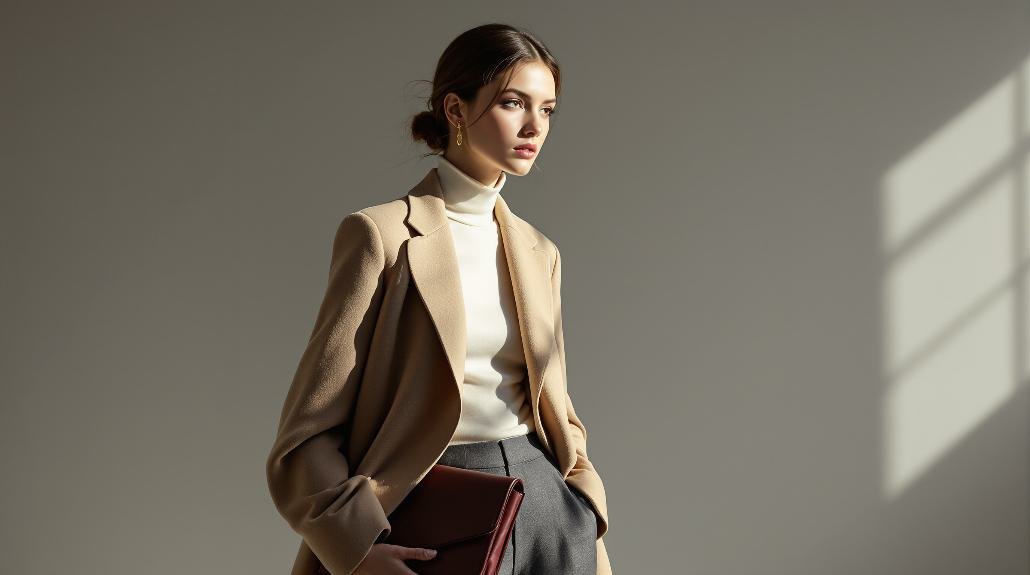
A $3,000 sweater becomes more desirable when no one can identify its origin. This is the paradox fueling quiet luxury’s economic engine—a movement preaching anti-consumerism while operating at price points accessible only to the wealthy.
The aesthetic promises democratic elegance through simplicity. Invest in fewer, better pieces. Reject trend cycles. Embrace timelessness over novelty. Yet the execution betrays the philosophy entirely. According to Bain & Company’s 2024 Luxury Report, the personal luxury goods market for understated, heritage-focused brands grew 12% year-over-year, outpacing logo-heavy competitors by nearly double.
Enter The Row, Loro Piana, and Brunello Cucinelli—offering neutrals, cashmere, and impeccable tailoring without visible branding. Their approach mirrors Tadao Ando’s architectural philosophy: restraint as statement, negative space as luxury. It’s stealth wealth disguised as ethical consumption.
The irony cuts deep. This “anti-bling movement” costs considerably more than the flashy logos it rejects. A Loro Piana baseball cap retails for $450. A Row tote exceeds $5,000. You either understand why that unadorned coat costs five figures, or you don’t—and that epistemic gatekeeping represents fashion’s newest form of social stratification.
The Philosophy Versus the Price Tag
The intellectual foundation borrows heavily from minimalist philosophy. Think Agnes Martin’s meditative grids or Shaker furniture’s principle that beauty emerges from perfect function. The aesthetic argument is compelling: quality over quantity, permanence over novelty.
But philosophy fractures against pricing reality. Business of Fashion reported that Loro Piana’s average transaction value exceeded €2,500 in 2023, while The Row’s waiting lists for certain handbags stretch beyond eighteen months. These aren’t accessible entry points to thoughtful consumption. They’re gatekeeping mechanisms dressed in cashmere.
The contradiction crystallizes here: quiet luxury markets itself as fashion’s antidote to excess while being, mathematically, more excessive per item than most logo-driven alternatives. A Gucci logo belt costs roughly $450. A Brunello Cucinelli belt in unadorned leather? Often triple that figure.
Proponents argue quality justifies cost—these pieces last decades. Yet McKinsey’s State of Fashion report found that even luxury consumers replace wardrobes at accelerating rates. The “buy less, buy better” mantra collapses when examined against actual purchasing behavior. We’re buying expensive and often.
Who Actually Benefits From Stealth Wealth
Quiet luxury’s primary beneficiaries aren’t consumers seeking escape from logo fatigue. They’re consumers seeking distinction from other wealthy people. The movement represents intra-class differentiation—old money distancing itself from new money, established wealth signaling differently than tech-boom millionaires.
Vogue Business analysis revealed that the core demographic skews toward inherited wealth and second-generation affluence. These buyers already own the logos. They’ve exhausted that particular status game. Now they’re playing a subtler one—recognizable only to those with identical cultural capital.
This dynamic mirrors Pierre Bourdieu’s theories on taste as social weaponry. Conspicuous consumption announces wealth to everyone. Inconspicuous consumption announces wealth only to those who already possess it. The Row’s $6,900 Margaux bag speaks exclusively to people who recognize it. Everyone else sees a simple leather tote.
The cruelty is architectural. Traditional luxury allows aspiration—save for the logo piece, join the club symbolically. Quiet luxury eliminates that entry point entirely. Without visible markers, there’s nothing to aspire toward, nothing to save for, no symbolic participation available.
The Authenticity Performance
Fashion’s quiet luxury moment arrived precisely when social media amplified authenticity as currency. Instagram exhaustion, influencer skepticism, and growing distrust of performative consumption created demand for something that felt genuine.
TikTok’s #quietluxury hashtag accumulated over 800 million views. Pinterest searches for “old money aesthetic” surged 34% during 2022-2023. The irony is almost too perfect: a trend predicated on rejecting performance became the most performed aesthetic in fashion history.
When Sofia Richie Grainge’s wedding coverage drove unprecedented traffic to quiet luxury content, something fundamental shifted. The aesthetic designed to reject spectacle became the spectacle. Stealth wealth transformed into a costume anyone could approximate with the right Pinterest board.
Philosopher Jean Baudrillard might recognize this moment—the simulation consuming the original. Quiet luxury’s meaning depended on its invisibility. Mass visibility destroyed the very thing being signaled. What began as genuine class distinction became Halloween costume, and the truly wealthy began their next migration. Where they’re heading, we don’t yet know.
The Counterargument: Where Critics Miss the Point
Before accepting quiet luxury’s self-congratulatory narrative, consider who this movement actually serves. Accessibility remains a fundamental problem. The Row’s cashmere sweaters retail at $2,400. Loro Piana’s “understated” loafers command $1,100. This isn’t democratic elegance—it’s exclusion dressed in neutral tones.
Where critics have a point: The environmental claims deserve scrutiny. Brunello Cucinelli, despite preaching longevity, still manufactures seasonally—producing new collections twice yearly like any other luxury house. Quiet luxury whispers about buying less while ensuring you buy expensive.
Where they’re wrong: Dismissing the entire philosophy ignores its genuine contributions. The craftsmanship matters. The shift toward buying fewer, better things matters. The challenge to conspicuous consumption matters—even if imperfectly executed.
The movement works best when you acknowledge what it is: a thoughtful alternative to logo-driven excess that still carries inherent elitism. Like Agnes Martin’s deceptively simple grids—which required extraordinary skill yet appeared effortless—the aesthetic performs accessibility while demanding resources most can’t summon.
The sweet spot? Borrowing the principles—neutral palettes, timeless cuts, quality fabrics—without requiring entry into an exclusive club. Younger shoppers increasingly adopt quiet luxury codes through vintage sourcing and mid-tier brands emphasizing similar design philosophies, suggesting the aesthetic’s influence extends beyond its price barriers.
What Should Change
If this movement claims to reject overconsumption, it must stop gatekeeping its own principles behind four-figure price tags. The contradiction is architectural—like Tadao Ando designing a meditation space accessible only by private helicopter.
Democratize the aesthetic. Accessible labels can deliver neutral palettes, quality construction, and minimal branding without the Loro Piana markup. You don’t need a $2,000 cashmere sweater to practice restraint. You need intentionality, not income brackets. Brands like COS, Arket, and Uniqlo’s premium lines prove this model works.
Demand transparency. Brands touting sustainability must prove it through supply chain disclosures and verified material sourcing. McKinsey found that only 23% of luxury houses provide comprehensive supply chain transparency, despite 78% claiming sustainability commitments in marketing materials. The gap between promise and proof undermines the entire philosophy.
Recognize the limits. Quiet luxury offers a specific kind of elegance to a specific demographic. Recognizing these boundaries is more honest than pretending they don’t exist. The philosophy survives even when the price tags don’t—prioritizing longevity over novelty translates across income levels.
The Verdict
Quiet luxury’s contradiction isn’t a bug. It’s the feature that makes it function. The movement succeeds precisely because it claims values it cannot fully deliver—accessibility, authenticity, sustainability—while serving more complex purposes. It’s fashion’s most sophisticated magic trick: selling exclusion as inclusion, performance as genuineness, extreme wealth as thoughtful restraint.
This matters beyond fashion criticism. Quiet luxury reveals how effectively aesthetics launder ideology, how visual language can make plutocracy appear democratic. When a $4,000 sweater represents “accessible simplicity,” language itself has been conscripted into service.
The trend will inevitably evolve, replaced by whatever contradiction fashion requires next. But its lesson persists. In an attention economy, even rejection of attention becomes attention-seeking. Even anti-fashion becomes fashion. Even silence, when performed loudly enough, becomes noise.
The revolution succeeded on its own terms. Now comes the harder work: maintaining relevance without becoming establishment, staying quiet without going silent. Maximalism will return—it always does. But quiet luxury has established permanent territory, offering refuge for those exhausted by fashion’s perpetual noise.
Perhaps the only authentic quiet luxury is the kind nobody writes about, nobody photographs, nobody knows exists. Which means, by definition, you’ve never seen it—and neither have I.
Frequently Asked Questions
How can consumers distinguish authentic quiet luxury from mass-market imitations?
Touch betrays everything. Authentic quiet luxury uses premium fibers measuring 14-16 microns for cashmere, compared to 19+ microns in fast-fashion alternatives. Check interior construction—French seams, pattern matching at junctions, and 22+ stitches per inch signal genuine quality. Research brand transparency on sourcing and manufacturing before purchasing.
What price range defines entry into true quiet luxury brands?
Entry-level pieces start around $500-$1,000 for accessories and basic knitwear from houses like Loro Piana or Brunello Cucinelli. Signature pieces—tailored coats, substantial leather goods—begin at $2,000 and climb significantly higher. The average quiet luxury wardrobe requires approximately €15,000 minimum investment.
Does quiet luxury work for all body types?
The aesthetic presents challenges. Unstructured silhouettes and oversized proportions were conceived on specific body types. Only 34% of luxury brands offer extended sizing beyond EU 46. However, the underlying principles—quality fabrics, timeless cuts, minimal branding—translate across body types when adapted thoughtfully rather than copied literally.
Can secondhand quiet luxury retain investment value?
Heritage house leather goods demonstrate strongest retention—Hermès bags appreciate an average of 14% annually. Tailored outerwear holds value well when properly maintained. According to The RealReal, understated luxury pieces retain 87% of retail value after five years, compared to 52% for heavily branded equivalents. Condition and documentation significantly impact resale pricing.

Lina, Founder, Creative Director & Editor-in-Chief
The mind behind Arahkaii. Lina launched the platform to spotlight the designers and brands she kept discovering and thinking “why isn’t anyone talking about this?” She brings a thoughtful, intentional approach to storytelling. She leads the editorial team with a focus on clarity, creative depth, and modern femininity, shaping narratives that feel both elevated and deeply human.She shapes everything from content strategy to editorial tone, is hands-on with every feature, and believes the best content makes you stop scrolling. Currently juggling platform-building, brand outreach, and defending her slow morning ritual as essential creative practice.

