
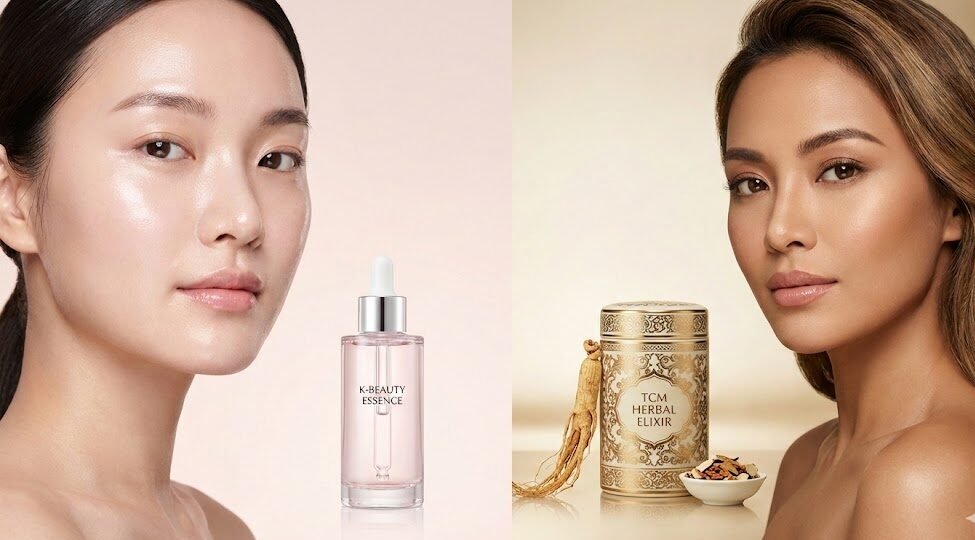
The C-Beauty vs K-Beauty rivalry is reshaping the global skincare industry, and choosing sides has never been harder. The beauty aisle has never felt more like a geopolitical map. Walk through any Sephora or scroll through TikTok, and you’ll notice two distinct forces reshaping how the world thinks about skincare: Chinese beauty (C-Beauty) and Korean beauty (K-Beauty). But here’s the thing—2026 isn’t about picking sides. It’s about understanding what each philosophy offers and why this rivalry is actually making all of us look better.
K-Beauty conquered the global market with its playful innovation and glass-skin promises. Now, C-Beauty is arriving with a different story altogether—one rooted in 3,500 years of Traditional Chinese Medicine and packaging so exquisite it belongs in museums. The question isn’t which is better. It’s which approach matches your skin, your values, and your vanity.
C-Beauty vs K-Beauty: What Actually Defines Each Beauty Philosophy
Before comparing products, we need to understand the fundamental differences in how these two beauty cultures think about skin.
K-Beauty’s Core Belief
Korean beauty operates on a simple but revolutionary premise: prevention trumps correction. The famous 10-step routine isn’t about vanity—it’s about treating skincare as daily maintenance rather than damage control. The goal is “glass skin,” that luminous, almost wet-looking dewiness that makes skin appear lit from within.
K-Beauty tends to layer lightweight, hydrating products that build upon each other. It favours innovative textures, playful packaging, and ingredients that sound slightly unusual to Western ears—snail mucin, fermented extracts, centella asiatica. The philosophy emphasizes gentleness and long-term skin health over aggressive treatments.
C-Beauty’s Core Belief
Chinese beauty draws from Traditional Chinese Medicine (TCM), which views the skin as a reflection of internal balance. Where K-Beauty asks “what does your skin need today?”, C-Beauty asks “what does your body need to heal?” It’s a holistic approach that connects skincare to diet, lifestyle, and the concept of Chi—the vital energy flowing through your body.
C-Beauty products often feature ingredients used in Chinese medicine for millennia: ginseng for circulation and radiance, goji berries for antioxidant protection, pearl powder for brightening, and snow mushroom for hydration. The aesthetic tends toward the ornate and culturally significant, with packaging that references Chinese heritage and artistry.
The Numbers Tell a Story
Both markets are experiencing remarkable growth, but in different ways.
K-Beauty by the Numbers
Global market valued at approximately $16.26 billion in 2025, projected to reach $38.29 billion by 2033 (11.3% annual growth). US sales surged to $2 billion in 2024—up 37% year-over-year. The US now accounts for over 51% of K-Beauty’s global online sales, surpassing China for the first time.
C-Beauty by the Numbers
Global market valued at $18.7 billion in 2025, projected to reach $49.2 billion by 2035 (10.2% annual growth). China’s overall beauty market expected to hit $78 billion by 2025. C-Beauty holds approximately 20% of the global beauty and personal care market.
The interesting shift? K-Beauty is winning hearts in America while facing tougher competition at home. Meanwhile, C-Beauty brands that once dominated domestically are now eyeing international expansion, with Florasis becoming the first Chinese beauty brand to open a counter at Paris’s prestigious Samaritaine department store.
Signature Ingredients: What Sets Them Apart
K-Beauty’s Star Ingredients
Snail Mucin – The ingredient that made people say “wait, what?” before they became obsessed. COSRX’s Snail Mucin Essence has achieved cult status for its ability to hydrate, repair, and soothe without irritation.
Centella Asiatica (Cica) – A calming, healing ingredient that’s become non-negotiable for sensitive skin types. Korean brands pioneered its modern skincare applications.
Fermented Ingredients – Galactomyces, saccharomyces, and other fermented compounds that enhance absorption and deliver antioxidant benefits.
PDRN (Polydeoxyribonucleotide) – The “salmon DNA” ingredient that’s entering mainstream K-Beauty for its regenerative properties.
C-Beauty’s Star Ingredients
Ginseng – The crown jewel of TCM skincare. Brightens, boosts circulation, prevents UV damage, and diminishes signs of aging. Pechoin has built an empire around this single ingredient.
Snow Mushroom (Tremella) – Often called “nature’s hyaluronic acid” and may actually outperform it for hydration. This white mushroom holds 500 times its weight in water.
Pearl Powder – Used by Chinese empresses for centuries to brighten skin tone and add luminosity.
Goji Berry – Packed with antioxidants and carotenoids that protect against environmental damage.
Mugwort (Artemisia) – Anti-inflammatory and soothing, particularly good for sensitive or acne-prone skin.
The Routine Face-Off
K-Beauty: The Famous Multi-Step Approach
The 10-step routine became K-Beauty’s calling card, though most Korean women don’t actually follow all ten steps daily. The traditional breakdown includes: oil cleanser, water-based cleanser, exfoliator, toner, essence, serum or ampoule, sheet mask, eye cream, moisturizer, and sunscreen (AM) or sleeping pack (PM).
The 2026 evolution: K-Beauty is streamlining. The industry is moving toward what experts call “slow aging”—focusing on maintaining skin health rather than chasing micro-trends. Mature consumers in their 30s and 40s are driving this shift toward fewer, more effective products.
C-Beauty: The Holistic Balance Approach
TCM skincare doesn’t follow a rigid step count. Instead, it emphasizes double cleansing with herb-infused oil cleansers, hydrating with herbal toners, treatment serums featuring concentrated TCM actives, facial massage with tools like Gua Sha and jade rollers, moisturizing with botanical extracts, and sun protection.
The unique element: C-Beauty often incorporates practices beyond products—facial acupuncture, cupping therapy, and dietary recommendations that support skin health from within.
Brand Breakdown: Who’s Leading Each Movement
K-Beauty Powerhouses
Medicube – Their AGE-R Booster Pro device went viral when Kylie Jenner was photographed using it. At-home devices are becoming central to K-Beauty’s 2026 strategy.
COSRX – The snail mucin originators remain essential. Their no-frills approach and affordable pricing made K-Beauty accessible globally.
Sulwhasoo – The luxury end of K-Beauty, combining traditional Korean medicine (Hanbang) with modern science.
Beauty of Joseon – Historical Korean beauty meets modern formulation, with their SPF serum achieving cult status.
C-Beauty Rising Stars
Florasis (Hua Xi Zi) – The packaging alone is worth the purchase. Their lipsticks feature hand-carved designs depicting ancient Chinese love stories. Pioneering C-Beauty’s global expansion with counters in Paris.
Proya – China’s largest homegrown beauty brand, with 2023 revenue of 8.9 billion yuan. They’ve established a research center in France.
Perfect Diary – The brand that proved Chinese beauty could outpace L’Oréal and Estée Lauder on domestic platforms.
Pechoin – A heritage brand founded in 1931 that’s reinvented itself for young consumers with ginseng-forward formulations.
The Aesthetic Divide: Glass Skin vs Atmospheric Beauty
Here’s where the philosophies diverge most visibly.
K-Beauty’s Glass Skin: The ideal is skin so hydrated and luminous it looks almost transparent—dewy, bouncy, reflective. Makeup tends toward the natural, with the skin itself as the star.
C-Beauty’s Atmospheric Beauty: The Douyin makeup trend emphasizes drama and self-expression. It’s about creating a mood or “vibe” through makeup as an artistic medium. Think bold lip colors, elaborate eye looks, and packaging that doubles as collectible art.
What’s Trending for 2026
K-Beauty Trends to Watch
SPF as Non-Negotiable – Sunscreen isn’t optional anymore. Hybrid formats like tinted sunscreens and cushion compacts with SPF are dominating.
Inner Beauty – Edible skincare is established. Expect more supplements targeting skin, hair, and stress—particularly around sleep and hormonal changes.
Post-Procedure Care – As lasers, peels, and injectables become normalized, K-Beauty is creating products specifically for compromised, recovering skin.
Daily Devices – Once reserved for special occasions, Korean skincare devices are now designed for everyday routines.
Cooling Care – Climate change is influencing formulation. Products that lower skin temperature and provide instant cooling are rising.
C-Beauty Trends to Watch
Modernized TCM – Traditional herbs paired with modern delivery systems. Expect ginseng, mugwort, and bamboo sap combined with peptides and encapsulation technologies.
Science-Backed Heritage – C-Beauty brands are investing heavily in R&D to validate traditional ingredients through clinical trials.
Cosmeceuticals – The line between skincare and medicine is blurring. Brands like Winona are building the “cosmeceutical” category.
Cultural Storytelling – Packaging that references Chinese dynasties, poetry, and art isn’t just aesthetic—it’s a differentiator in Western markets seeking authenticity.
How to Choose: A Practical Guide
Choose K-Beauty if you: love multi-step routines and skincare as self-care ritual; prefer lightweight, layerable textures; want to prevent aging before it starts; enjoy trying new, innovative products; have oily, combination, or acne-prone skin (Korean brands excel at oil control); or love cute or minimal packaging.
Choose C-Beauty if you: prefer a holistic approach connecting inner and outer health; want products with cultural heritage and storytelling; have dry or mature skin (TCM ingredients excel at nourishment); appreciate ornate, collectible packaging; are drawn to natural and herbal ingredients; or want to explore facial tools like Gua Sha as part of your routine.
Or do what smart beauty consumers do: Combine both. Use K-Beauty for hydration, layering, and barrier support. Use C-Beauty for targeted treatments, facial massage tools, and products featuring specific TCM actives.
The Bottom Line
In 2026, the most sophisticated beauty consumers aren’t asking “C-Beauty or K-Beauty?” They’re asking “what do I need today, and which philosophy answers that need best?”
Some mornings call for a streamlined K-Beauty routine with lightweight essences and powerful SPF. Some evenings call for C-Beauty’s Gua Sha ritual and ginseng-rich serums. Some weeks call for Korean sheet masks. Some months call for TCM supplements that support skin health from within. For further reading, see WWD Beauty.
The real trend isn’t choosing sides. It’s becoming fluent in both languages of Asian beauty—and speaking whichever one your skin needs to hear.
Related Reading
- 10 Korean Fashion Brands Building Global Empires
- Seoul Fashion Week F/W 2026
- K-Beauty Broke the Algorithm

Nadra
Co-Founder & Head of Content
The Gen Z co-founder behind Arahkaii’s content strategy. She shapes stories that feel elevated yet genuinely worth reading — modern, meaningful, and thoughtfully crafted. Nadra oversees editorial standards and ensures everything published reflects real quality, not just what’s trending.
When she’s not editing or building the platform, she’s hunting for vintage finds, curating playlists to match the vibe, or getting lost in a good book — always on the search for the city’s best matcha.

