
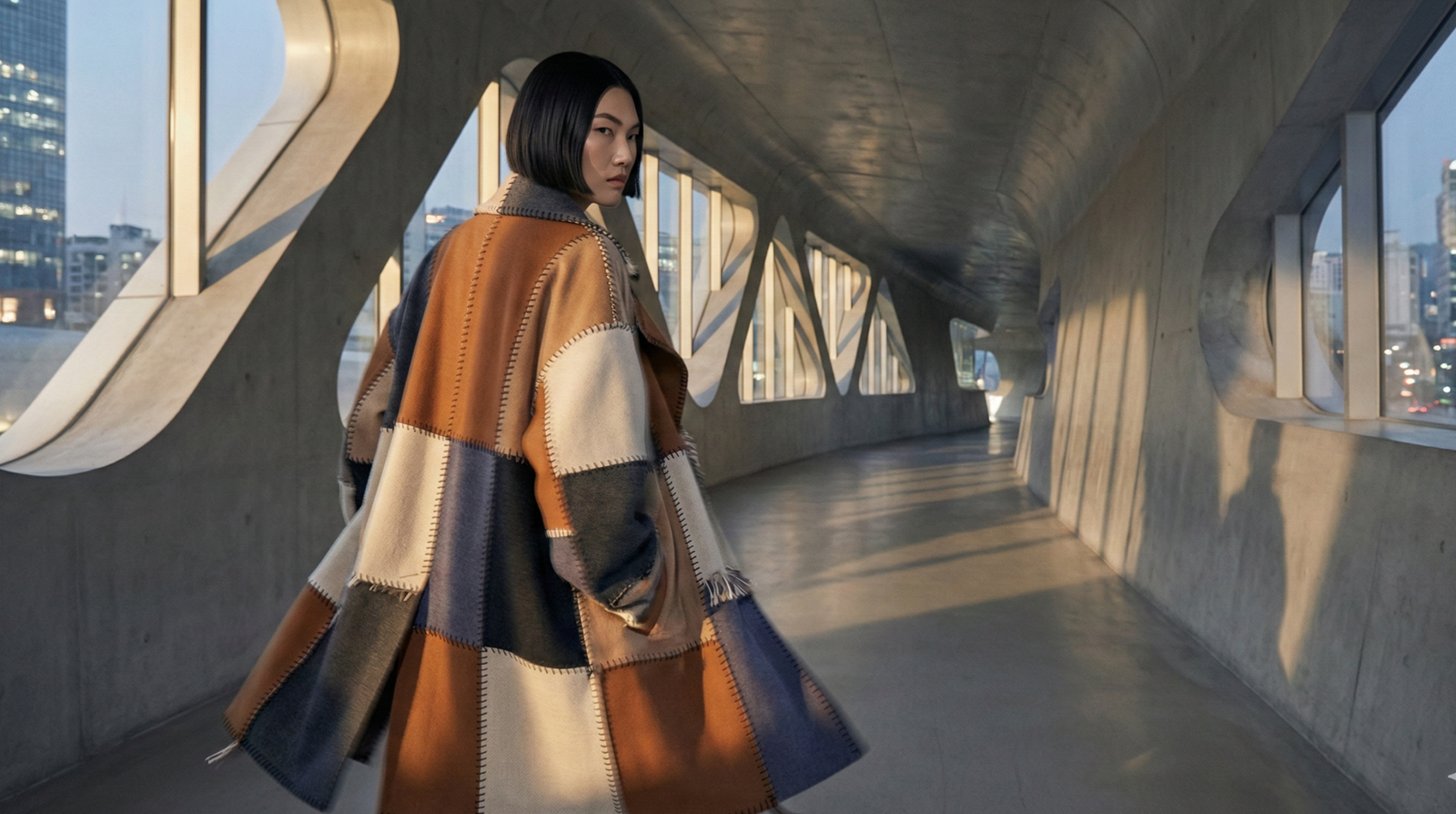
Seoul Fashion Week just wrapped its most strategically important season yet. Forget the celebrity front rows—these five collections tell the real story of where Korean fashion is headed.
The F/W 2026 edition, which ran February 3–8 at Dongdaemun Design Plaza, brought 24 brands across 15 runway shows and 9 presentations—all consolidated under one roof for the first time. A hundred buyers from 20 countries showed up, including representatives from Harvey Nichols, Urban Outfitters, Printemps, and Club21 Singapore. This isn’t a discovery market anymore. This is a fashion week that’s demanding you pay attention.
The five collections that defined this season did more than simply impress—they crystallised something precise about where K-fashion is headed next. And the trajectory? Genuinely compelling.
MÜNN: Why a Korean Designer Left Milan to Open Seoul Fashion Week 2026
Let’s start with the opening show, because it set the tone for everything.
MÜNN, designed by Han Hyun-min, hasn’t shown at Seoul Fashion Week in six years. Six. The brand decamped to Milan, built an international profile, earned the kind of European credibility that Korean designers have historically chased like it’s the last train out of Gangnam—and then deliberately came back to Seoul to open the F/W 2026 season.
That return is a statement in itself. But the collection made an even bigger one.
Han presented sweaters knit from recycled paper. Dresses constructed from discarded banners. Bustiers handwoven from elastic bands. This isn’t sustainability as a design language—it’s sustainability as a design language, where the constraints of unconventional materials become the creative engine. The silhouettes were sharp, wearable, and completely devoid of the “eco-fashion compromise” that plague so many sustainable collections. Nothing looked like it was trying to be virtuous. It just looked good.
The bigger narrative here is what I’m calling the “boomerang effect”—Korean designers who leave for global fashion weeks and then choose to come home. MÜNN’s return to Seoul suggests that the city’s value proposition has shifted. It’s no longer just a launching pad. It’s a destination.
MMAM: How “Emerging Layers” Bridges Global Ambition and Korean Fashion Wearability
MMAM’s Park Hyun might have delivered the most honest quote of the entire fashion week: after showing in New York in 2024 and Paris in 2025, she deliberately centered her F/W 2026 collection on Seoul to create “items that our local customers can actually wear.”
Read that again. A designer who’s done the global circuit actively choosing to prioritise wearability for her home market. In an industry that loves to reward impracticality, this is a quietly radical move.
The collection, titled “Emerging Layers,” took innerwear materials and pulled them outward—pajamalike fabrics styled with tailored coats, intimate textures meeting structured silhouettes. It’s the kind of design concept that could easily tip into gimmick territory, but Park executed it with restraint and precision. The layering felt intentional rather than conceptual, cosy rather than costumey.
MMAM represents something important about the current moment in Korean fashion: the tension between global ambition and local relevance. K-fashion brands are figuring out that you don’t have to choose. You can show in Paris and design for Seoul. The two aren’t mutually exclusive—they’re actually reinforcing.
Kwak Hyunjoo Collection: How Korean Heritage Craft Gives K-Fashion Its Competitive Edge
If there was a collection that made the strongest case for K-fashion’s unique competitive advantage, it was Kwak Hyunjoo’s.
Kwak has been doing something that, frankly, nobody in Western fashion can replicate: taking traditional Korean craft techniques—specifically hanbok layering principles and jogakbo patchwork—and translating them into contemporary silhouettes that feel absolutely modern. Not “heritage-inspired.” Not “a nod to tradition.” Actual structural integration of centuries-old textile techniques into garments you’d wear to a dinner reservation in Gangnam or a gallery opening in Hannam-dong.
Jogakbo, for those unfamiliar, is the Korean art of wrapping cloth made from pieced-together fabric scraps—originally a form of creative recycling practiced by Korean women during the Joseon dynasty. Kwak uses this patchwork methodology as a construction principle, creating garments where the seaming itself becomes the design feature. The F/W 2026 pieces layered translucent fabrics over structured bases, producing a depth of texture that’s genuinely difficult to achieve through conventional construction.
Here’s why this matters beyond aesthetics: K-fashion’s most distinctive design language isn’t streetwear. It isn’t K-pop merch. It’s this—the intersection of heritage craft and material innovation. It’s a lane that European and American designers can’t occupy because they simply don’t have the cultural toolkit. Kwak Hyunjoo isn’t just making beautiful clothes. She’s building a competitive moat.
Kwak herself has been vocal about wanting SFW to be “not just about making sales” but about providing diverse creative space—a perspective that challenges the purely commercial narrative while acknowledging that commercial success and creative integrity can coexist.
HANNAH SHIN: Biomimetic Couture and Seoul’s Fashion-Tech Frontier
Okay, this one’s for the futurists.
HANNAH SHIN has been operating at the intersection of fashion technology and sustainability for a while now, but her F/W 2026 presentation pushed the concept further than anything we’ve seen on a Korean runway. Think biomimetic design—garments that take structural and aesthetic cues from natural organisms—executed through 3D printing and light-based design techniques, all using sustainable materials.
If that sounds like it belongs more in a design museum than a department store, you’re not wrong. But that’s precisely the point. Seoul Fashion Week has historically been criticised for playing it safe, for prioritising commercial viability over creative risk. HANNAH SHIN’s inclusion in the lineup—and the enthusiastic reception it received—signals that the event’s organisers understand that a credible fashion week needs both wearable collections and boundary-pushing ones.
This also connects to a broader trend in the Korean fashion ecosystem. The 25th anniversary S/S 2026 edition (held back in September 2025) featured an AI-driven fashion exhibition alongside the traditional runway shows, and Seoul Metropolitan Government has been explicitly investing in fashion-tech convergence. Korea’s advantage here is obvious: when your country is home to Samsung, LG, and some of the world’s most advanced manufacturing infrastructure, bridging fashion and technology isn’t just a creative exercise. It’s an industrial strategy.
The Broader Lineup: How Korean Fashion Brands Are Trading Maximalism for Maturity
Beyond the headline collections, the overall F/W 2026 season had a distinct mood: experimentation meets wearability. That might sound like a contradiction, but it’s actually the most interesting creative tension in Korean fashion right now.
Across the 24 participating brands, there was a noticeable shift away from the streetwear-inflected maximalism that defined K-fashion’s initial global breakthrough. The palette was muted. The proportions were considered. The attitude was less “look at me” and more “I know what I’m doing.” It’s the visual equivalent of K-fashion growing up—moving from a phase of loud self-introduction to one of quiet self-assurance.
This maturation was reinforced by the Seoul Fashion Forum, co-hosted with WWD Korea and themed “The Next Chapter of K-Fashion: Deep Dive & Inspiring.” Jörn Zempel, President of LOEWE Korea, delivered a keynote arguing that K-fashion’s competitive edge lies not in aesthetics alone but in “experiences that connect emotionally with the world.” When a European luxury executive is publicly validating your creative philosophy at your own fashion week, the power dynamic has officially shifted.
What Seoul Fashion Week F/W 2026 Means for the Future of K-Fashion
Let’s zoom out.
Seoul Fashion Week F/W 2026 wasn’t perfect. Designers have called for longer preparation timelines and greater diversity in the lineup. Samsung Fashion Research Institute projects only about 2.4% growth for the Korean fashion market in both 2025 and 2026—modest numbers that suggest the gap between K-fashion’s cultural influence and its commercial conversion is still real. Google searches for Korean fashion terms have grown 200% over three years, but search interest alone doesn’t pay pattern-makers.
But here’s what this season got right: it stopped trying to be a smaller version of Paris or Milan and started leaning into what makes it genuinely different. The government-backed infrastructure that treats fashion week as economic development rather than pure spectacle. The designers who are coming home because Seoul’s value proposition now makes strategic sense. The heritage-craft-to-material-innovation pipeline that no other country can replicate. The fashion-tech convergence backed by actual industrial capability.
These five collections didn’t just show us good clothes. They showed us a fashion industry that’s figuring out its own rules.
And in a global fashion landscape that’s increasingly exhausted by its own conventions, that might be the most exciting thing happening on any runway right now — one of the most compelling emerging trends in fashion today.

Natalia Amir
Feature Writer, Fashion & Lifestyle
With a passport as storied as her byline, Natalia Amir brings a global lens to luxury fashion and contemporary living. Having contributed to international brands across continents, she possesses that rare ability to translate the pulse of global style into narratives that resonate deeply with Asia’s discerning audience. Her writing is informed by years immersed in the luxury market—understanding not just what’s covetable, but why it matters. At Arahkaii, she leads our fashion and lifestyle coverage with intelligence, elegance, and an eye for the extraordinary in the everyday.

