
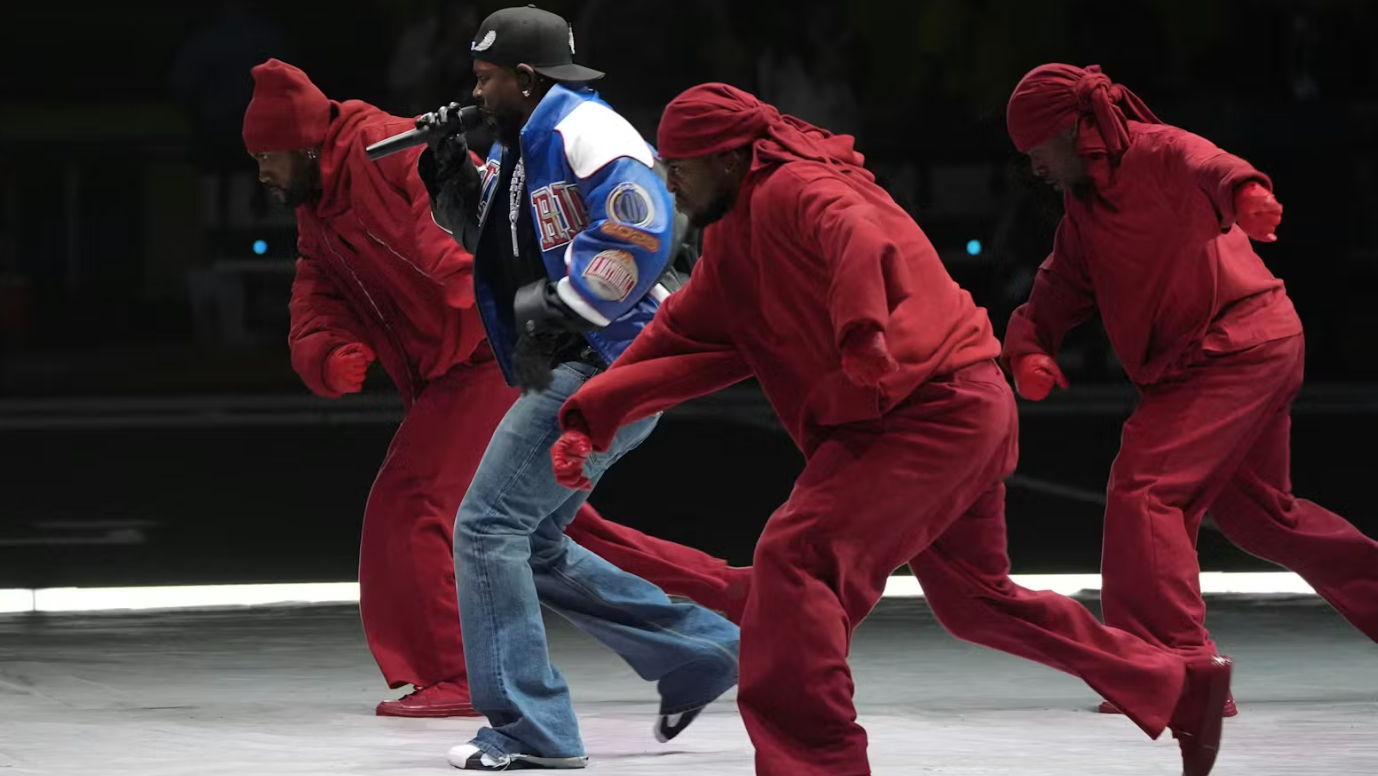
When the most-watched stage in entertainment met hip-hop’s most strategic artist, a pair of women’s flared jeans became fashion’s biggest conversation—and the luxury industry’s most studied case of cultural arbitrage.
Kendrick Lamar wore women’s jeans two sizes too small, a $68,000 diamond brooch, and sneakers honoring a football legend, then performed the most-watched diss track in Grammy history. The outfit generated $2.3 million in Media Impact Value. The jeans cost $1,200.
This is not a story about fashion. This is a story about what happens when cultural capital, strategic partnership, and 130 million eyeballs converge in a 13-minute window—and how the luxury industry measures value in an era when a single halftime performance can eclipse a year’s worth of traditional advertising.
On February 9, 2025, seven days after winning a record-breaking five Grammy Awards for “Not Like Us”—his surgical diss track aimed at Drake—Kendrick Lamar took the Super Bowl LIX stage wearing Celine Marco Jeans in Dark Union Wash. The jeans, a women’s style from Hedi Slimane’s Spring/Summer 2020 collection, had spent five years in relative obscurity. By 9 PM Eastern that Sunday, they had generated more media value than most fashion campaigns generate in a fiscal quarter.
According to Launchmetrics, the industry’s leading media impact measurement platform, those jeans alone generated $2.3 million in Media Impact Value (MIV). Google searches for “flared jeans” spiked 5,000% within 48 hours. Celine mentions on X (formerly Twitter) surged over 4,000%. The Nike Air DT Max ’96 sneakers he paired with the look—a tribute to football legend Deion Sanders—saw overnight sales jump 413% on StockX.
But here’s what most coverage missed: this wasn’t an accident. It wasn’t a stylist’s whim. It was the culmination of a three-year strategic partnership between pgLang, the creative collective Kendrick co-founded with Dave Free, and Celine’s parent company—a relationship that transformed hip-hop’s most secretive artist into fashion’s most valuable Super Bowl placement. The trajectory mirrors what we’ve seen with content creators becoming founders—strategic vision trumping viral happenstance.
The Anatomy of a $70,000 Outfit
To understand how Kendrick’s Super Bowl look generated such extraordinary value, you first need to understand what he was wearing—and what each piece communicated to the 130 million viewers watching.
| Item | Brand | Details | Price |
|---|---|---|---|
| Jeans | Celine | Marco Jeans, Dark Union Wash, Size 29 (women’s) | $1,200 |
| Jacket | Martine Rose | Custom leather varsity, “Gloria” front, “pgLang” back | Custom |
| T-Shirt | NAHMIAS | Custom black, “keep them away from me” back | $266 |
| Sneakers | Nike | Air DT Max ’96 “Colorado Away” (Deion Sanders tribute) | $170 |
| Brooch | Rahaminov Diamonds | Angel Wing with Marquise Cut & Half Moon Sunset Diamond | $68,000 |
| Necklace | Custom | “a” pendant (pgLang/”A minor” reference) | N/A |
| Total Outfit Value: | $70,000+ | ||
Stylist: Taylor McNeill (also styles Timothée Chalamet; jeans reportedly originally pulled for Chalamet)
The foundation was those Celine Marco Jeans—$1,200 retail, Size 29, women’s cut. The choice was deliberate: a slim, high-waisted silhouette that challenged traditional masculine presentation while channeling the bootcut revival that had been building momentum in high fashion circles since 2023. This kind of gender-fluid styling represents an emerging trend reshaping how luxury brands approach their customer base.
Layered atop was a custom Martine Rose leather varsity jacket, featuring “Gloria” embroidered on the front—a reference to Kendrick’s late grandmother—and “pgLang” on the back. The jacket alone signals the merger of personal narrative with brand identity that defines Kendrick’s approach to public presentation.
At his collar sat the outfit’s most expensive element: a Rahaminov Diamonds angel wing brooch featuring marquise cut and half moon sunset diamonds, valued at $68,000. Around his neck, a custom pendant featuring a lowercase “a”—simultaneously a pgLang reference and a nod to the key of A minor, musically significant in hip-hop production.
On his feet: Nike Air DT Max ’96 in the “Colorado Away” colorway, a $170 tribute to Deion Sanders. The choice bridged cultural worlds—sports, music, and fashion—in a single pair of sneakers.
What $2.3 Million in Media Value Actually Measures
The $2.3 million figure comes from Launchmetrics’ Media Impact Value metric, and understanding what MIV actually measures is essential to understanding what Kendrick’s moment really meant for the luxury fashion industry.
MIV is a proprietary algorithm that assigns dollar values to media placements across print, online, and social channels based on reach, engagement, and the quality of the placement context. It’s become the industry standard for quantifying what was previously unquantifiable: the monetary worth of brand visibility.
$2.3MMedia Impact Value generated by a single pair of $1,200 jeans in 13 minutes
But MIV has important limitations that most coverage glosses over. The metric tracks exposure, not confirmed purchases. High MIV doesn’t guarantee positive sentiment—a viral disaster and a viral triumph can generate similar numbers. And the methodology itself is proprietary, meaning it cannot be independently audited or replicated.
That said, industry validation remains strong. The New York Times, Vogue, WWD, and Forbes all reference MIV in fashion business coverage. Launchmetrics reports that 42% of fashion and lifestyle professionals use MIV metrics for campaign evaluation.
MIV Benchmarks & Comparisons
| Event/Celebrity | Brand | MIV | Context |
|---|---|---|---|
| Kendrick Lamar jeans | Celine | $2.3M | Single item, 13-min performance |
| Taylor Swift Super Bowl | Multiple | $76.9M | As spectator (11% of coverage) |
| Rihanna Fenty touch-up | Fenty Beauty | $11.3M | 3-second moment |
| Zendaya Met Gala 2024 | Margiela + Givenchy | $32.7M | 2 looks |
| Tyla Met Gala 2024 | Balmain | $26.8M | Sand dress |
| Bad Bunny Calvin Klein | Calvin Klein | $2.3M | Single GQ TikTok |
What made Kendrick’s number remarkable wasn’t its magnitude—it was its efficiency. A single garment, worn during a 13-minute performance, generating $2.3 million in trackable brand value represents a cost-per-impression of roughly $0.02 across 130 million viewers. For comparison, the average Super Bowl commercial costs approximately $7 million for 30 seconds of airtime.
The pgLang-Celine Partnership: Fashion’s Hidden Power Move
When Kendrick Lamar walked onto the Super Bowl stage wearing Celine, fashion insiders recognized something the general public missed: a strategic partnership years in the making.
pgLang, the creative collective Kendrick founded with longtime collaborator Dave Free in 2020, has positioned itself at the intersection of music, fashion, and visual culture. The company has maintained partnerships with Celine dating back to at least 2022, though the terms and scope of those relationships remain characteristically opaque—consistent with Kendrick’s broader approach to public communication.
This represents a fundamental shift in how artists approach fashion relationships. The traditional model—one-off styling pulls, red carpet loans, occasional paid endorsements—has given way to something resembling equity partnerships, where artists become strategic brand ambassadors with input into how their fashion choices are deployed. It’s a philosophy that aligns with our conscious luxury manifesto—authentic alignment over transactional endorsement.
The Super Bowl halftime show is, by this logic, fashion’s most valuable runway. No Fashion Week presentation, regardless of front-row star power, commands 130 million simultaneous viewers. No Met Gala red carpet generates 48 hours of continuous global news coverage. No magazine cover shoot gets replayed, analyzed, and memed across every major social platform within minutes.
Kendrick and pgLang appear to understand this better than most. Every element of his Super Bowl outfit served dual purposes: personal expression and brand amplification. The Celine jeans weren’t just fashion choices—they were media placements. The Martine Rose jacket wasn’t just a garment—it was a pgLang billboard.
From Hedi’s Vision to History’s Biggest Stage
Perhaps the most overlooked dimension of Kendrick’s Celine moment is the journey of the jeans themselves: designed by Hedi Slimane for the Spring/Summer 2020 collection, sitting in relative obscurity for five years, then suddenly thrust into the most-watched fashion moment of 2025.
Hedi Slimane’s tenure at Celine (2018-2024) was defined by skinny silhouettes, rock-and-roll energy, and a deliberate rejection of the maximalism dominating luxury fashion. The Marco Jeans, with their high waist, boot cut, and women’s sizing, exemplified Slimane’s approach: androgynous, historically referential, and decidedly counter to the oversized, streetwear-influenced trends that dominated late-2010s fashion.
When Slimane designed those jeans in 2019, TikTok had barely launched. COVID hadn’t yet reshaped global culture. Kendrick Lamar hadn’t yet released Mr. Morale & The Big Steppers. The idea that a pair of women’s flared jeans would become the defining fashion item of a Super Bowl halftime show would have seemed absurd.
Yet fashion operates on strange timelines. The bootcut revival that Slimane anticipated in 2020 has fully materialized by 2025. What seemed out of step five years ago now reads as prescient. Kendrick’s choice to wear those specific jeans, from that specific collection, suggests a styling team with deep fashion literacy and a deliberate intention to make a statement about cyclical trends and archive appreciation.
The 5,000% spike in Google searches for “flared jeans” post-performance indicates that statement landed. This kind of viral fashion moment demonstrates how a single cultural event can reshape consumer behavior overnight.
The Drake-Kendrick Fashion Wars: Sartorial Subliminal Messaging
The Super Bowl halftime show didn’t occur in cultural isolation. It came exactly one week after Kendrick won a record five Grammy Awards for “Not Like Us,” his surgical diss track targeting Drake. Every styling choice was therefore analyzed not just for fashion merit but for potential subliminal messaging in hip-hop’s most consequential rivalry.
This creates a secondary layer of media value that traditional fashion metrics struggle to capture. When Kendrick performed “Not Like Us” before 130 million viewers, every element of his presentation became part of the narrative: the custom jacket with “Gloria” honoring his late grandmother, the T-shirt declaring “keep them away from me,” the pendant referencing the key of A minor.
Fashion becomes text in this context. Drake, who has cultivated relationships with brands like Canada Goose, Nike, and various luxury houses throughout his career, found himself competing not just in streaming numbers or Grammy counts but in the visual language of cultural presentation.
The diamond brooch—$68,000 of angel wing imagery—carried its own messaging. Angels, protection, divine favor: precisely the imagery Kendrick invoked throughout his Grammy speech and “Not Like Us” lyrics. The Deion Sanders tribute sneakers extended the metaphor: a champion athlete known for both excellence and showmanship, bridging the worlds of sports and entertainment that Super Bowl Sunday uniquely commands.
Gender-Fluid Luxury: The Business of Men in Women’s Wear
Kendrick wearing women’s jeans to the Super Bowl represents more than a styling choice—it reflects a broader shift in how luxury fashion approaches gender categorization and the commercial implications of that evolution.
The global luxury denim market reached $16.2 billion in 2023, with gender-neutral and cross-gender styling emerging as significant growth categories. Brands including Gucci, Bottega Veneta, and Saint Laurent have increasingly presented gender-fluid collections, blurring traditional lines between men’s and women’s departments.
For Kendrick, the choice aligns with a decade of hip-hop artists challenging masculine fashion norms: Young Thug in dresses on album covers, A$AP Rocky’s ongoing fashion experimentation, Lil Nas X’s red carpet gender play. What distinguishes Kendrick’s approach is its subtlety—the jeans read as fashion-forward rather than provocative, making a statement while maintaining commercial viability.
The Super Bowl audience skews more traditionally masculine than Fashion Week crowds, which makes Kendrick’s choice strategically interesting. He normalized women’s jeans for 130 million viewers in a context associated with hypermasculine sporting culture. Whether this translates to broader market shifts in men’s willingness to shop across gender categories remains to be measured, but the precedent has been set at the highest possible visibility level.
What the Fashion Industry Should Learn
Kendrick Lamar’s Super Bowl moment offers several strategic lessons for brands seeking similar cultural impact.
Authenticity generates outsized returns.
The pgLang-Celine partnership appears to reflect genuine aesthetic alignment rather than purely transactional endorsement. Kendrick’s fashion choices feel coherent with his broader artistic identity, lending credibility that purely paid placements struggle to achieve.
Cultural timing multiplies value.
Kendrick performed one week after his Grammy triumph, with “Not Like Us” still dominating cultural conversation. Fashion choices made in that window received additional scrutiny and coverage they wouldn’t have received in isolation.
Archive investment pays dividends.
Five-year-old Celine jeans became the most-discussed fashion item of 2025. Brands with deep archives and patient strategies can see unexpected returns when the right cultural moment arrives.
Platform matters more than placement.
The Super Bowl halftime show is, objectively, fashion’s most valuable stage. Brands seeking similar impact should evaluate cultural touchpoints not by traditional fashion metrics but by raw audience reach and engagement intensity.
Cross-cultural bridging creates compound value.
The Deion Sanders sneakers connected fashion to sports; the pgLang jacket connected fashion to music; the overall presentation connected luxury to hip-hop. Each bridge created additional audience segments and coverage opportunities.
The Limits of Measurement
For all the sophistication of Media Impact Value calculations and the precision of Google Trends data, Kendrick’s Super Bowl moment also illustrates the fundamental limits of fashion’s value measurement systems.
Did the $2.3 million MIV translate to $2.3 million in sales? Unknown and likely unknowable. MIV measures visibility and engagement, not purchase intent or conversion. Celine’s website reportedly experienced inventory pressure post-performance, but precise sales figures aren’t public.
Did the 5,000% spike in “flared jeans” searches benefit Celine specifically, or did it lift the broader bootcut market? Google Trends doesn’t differentiate between brands within category searches. The rising tide may have lifted all flared-jean boats.
These questions aren’t answerable with current measurement tools, which is itself an important insight. Fashion’s rush to quantify everything risks obscuring the irreducible elements of cultural impact: taste, timing, authenticity, and the mysterious alchemy of the right person wearing the right thing at the right moment.
The New Economics of Cultural Capital
When the final notes of Kendrick Lamar’s halftime performance faded and 130 million viewers returned to their chicken wings and betting apps, the fashion industry had witnessed something unprecedented: the complete merger of cultural spectacle, strategic partnership, and measurable brand impact.
The $2.3 million figure for those Celine jeans will be cited in boardrooms and pitch decks for years. Brands seeking Super Bowl partnerships will reference Kendrick’s ROI when negotiating with future halftime performers. Stylists will study Taylor McNeill’s choices the way film students study Scorsese shot compositions.
But the deeper lesson transcends the numbers. Kendrick Lamar’s Super Bowl moment succeeded because it was coherent—every element, from the archive Celine to the custom pgLang jacket to the Deion Sanders tribute sneakers, contributed to a unified narrative of artistic excellence, cultural confidence, and strategic precision.
Fashion, at its best, tells stories. Kendrick told a story about heritage (grandmother Gloria), excellence (Grammy domination), and cultural bridging (sports-music-fashion fusion) in a 13-minute window. The brands along for that ride received value no traditional advertising could replicate.
The question now becomes: can this be reverse-engineered? Or does authentic cultural impact require the kind of long-term relationship-building and artistic credibility that can’t be bought, only earned?
For Celine, for pgLang, and for the luxury industry watching closely, the $2.3 million jeans have provided the data. What they do with it remains to be seen.
The Super Bowl halftime show has become fashion’s most valuable runway. In 13 minutes, Kendrick Lamar demonstrated what happens when cultural capital meets strategic partnership—and gave the luxury industry a masterclass in the economics of spectacle.
For more analysis on the intersection of culture, commerce, and style, explore The Journal or discover what’s shaping fashion’s trending conversations.
Robert writes Arahkaii’s Living & Travel stories with a focus on meaningful experiences, thoughtful exploration, and the quiet beauty found in everyday life. Blending practical insight with a storyteller’s eye, he highlights destinations, home rituals, and lifestyle perspectives that encourage readers to slow down, savor the moment, and travel with intention.
With a background in creative writing and cultural research, Robert gravitates toward narratives that reveal the heart of a place—its people, textures, and small details often overlooked. Whether he’s documenting hidden-city corners or reflecting on simple living, his work brings a sense of warmth and grounded curiosity. Outside of writing, he enjoys photography, morning walks, and discovering local cafés wherever he goes.

