
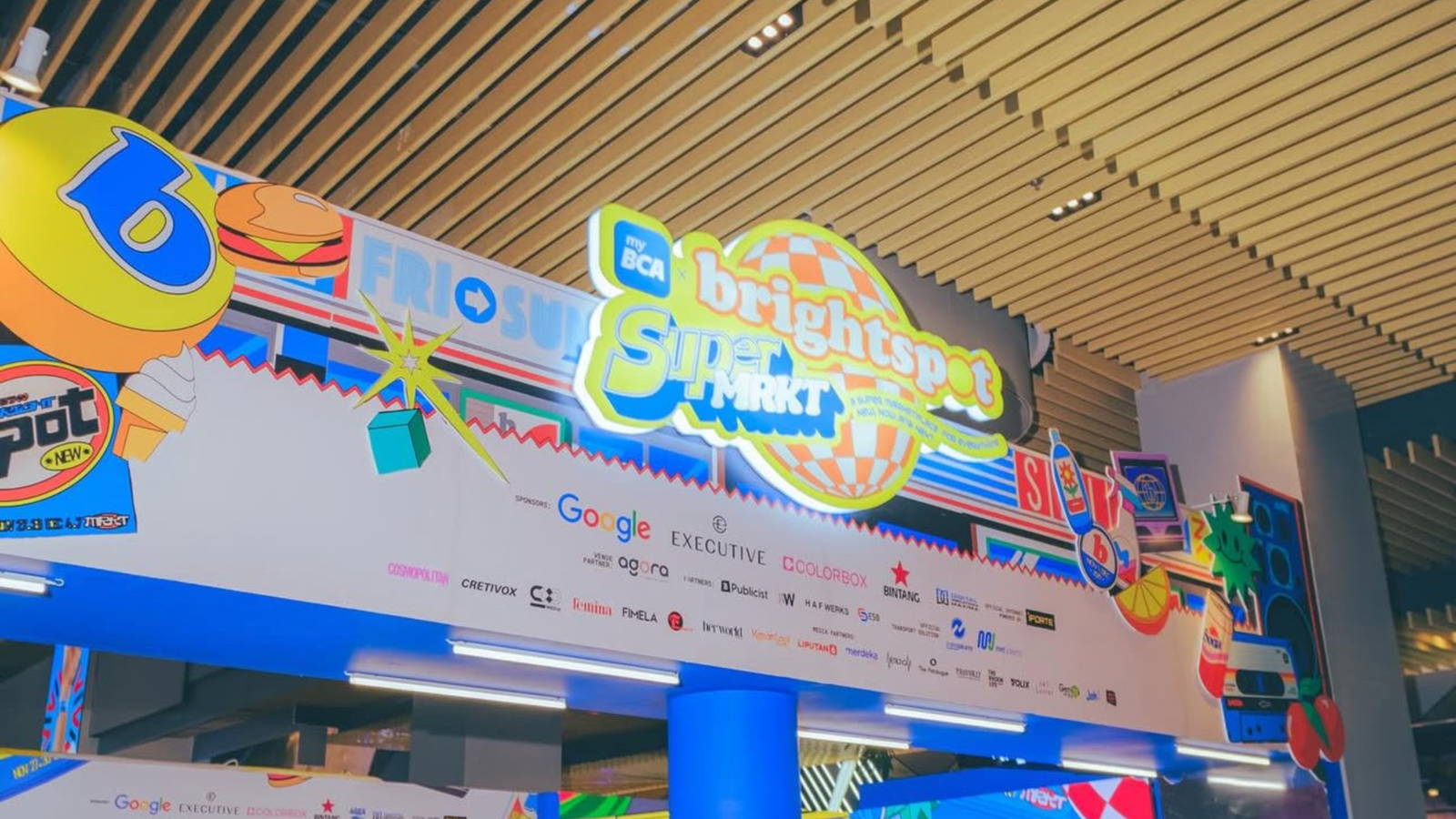
Indonesia’s most influential creative market returns with a bold new concept, transforming Agora Lifestyle Mall into a retro-futuristic playground for 220+ of the nation’s most exciting local brands.
There’s something almost spiritual about the way Indonesians approach markets. The pasar has always been more than commerce—it’s theater, community, discovery. Anton Wirjono understood this when he launched Brightspot Market in 2009 with just 25 vendors and a warehouse aesthetic borrowed from Brooklyn. Sixteen years later, his creation has become the country’s most important incubator for creative entrepreneurship, a place where Indonesian local brands are born, discovered, and occasionally plucked for permanent retail glory.
The 2025 edition, running December 4–7 at Agora Lifestyle Mall Jakarta, introduces the “SuperMRKT” concept—a knowing wink at the mundane grocery run reimagined as creative pilgrimage. “We want to revive the supermarket atmosphere, where everyone comes to look for the things they need, but also find unexpected things,” Wirjono explains. It’s a fitting metaphor for an event that has always excelled at surprise.
The Numbers Tell a Story
This year’s curation emerged from nearly 7,000 applications—a figure that speaks to both the desperation and ambition coursing through Indonesia’s creative class. Forty percent of submissions came from food vendors alone, reflecting the post-pandemic explosion in artisanal F&B. The final 220+ brands represent a 65-35 split between fashion/lifestyle and culinary offerings, each vetted for quality, design coherence, and commercial viability.
The selection process has become increasingly ruthless. Previous editions hosted nearly 300 tenants; the deliberate reduction signals maturation. Quality over quantity. Curation over crowd-pleasing.
The pipeline from Brightspot booth to permanent retail tells the story best. Eatlah—the salted egg phenomenon that became a multi-location empire—tested market response here before scaling into a proper operation. Dough Lab refined its positioning through Brightspot weekends before securing its permanent home. For brands navigating the gap between Instagram following and legitimate business, this remains Jakarta’s proving ground. Mall developers from Plaza Indonesia to Plaza Senayan regularly scout the floor. A strong showing here can mean the difference between Instagram hustle and real retail presence.
Inside the SuperMRKT
The venue occupies Level 2 of Agora Lifestyle Mall in Thamrin Nine—Jakarta’s newest premium development, mercifully accessible via MRT (Dukuh Atas), LRT, and TransJakarta. The layout borrows supermarket logic: light snacks and beverages greet visitors at the entrance, flowing into fashion and accessories, with substantial dining options anchoring the back.
Visual artist Ardhira Putra—whose work previously illuminated The Sphere in Las Vegas—designed the event’s identity. His aesthetic mines 90s nostalgia through a pop-art lens: bold colors, vintage advertising tropes, the warm glow of cassette-tape futurism. Every corner begs for documentation. The art direction alone justifies attendance.
Operating hours accommodate Jakarta’s rhythms: 10 AM to 10 PM Thursday through Friday, extending to midnight Saturday, with Sunday doors opening at 11 AM.
The Fashion Floor: Local Brands Worth Your Attention
The retail offering spans the full spectrum of Indonesian fashion ambition—but the real story lies in the labels that have earned their place through years of quiet excellence.
Shop at Velvet
Shop at Velvetrepresents the backbone of Indonesian contemporary fashion. Founded in 2011 by Yessi Kusumo, the label has spent over a decade perfecting what Indonesian wardrobes actually need: well-constructed pieces that transcend seasons. While flashier brands chase trends, Shop at Velvet has built a devoted following on the radical proposition that quality and timelessness still matter. Their Brightspot presence feels less like market participation and more like elder statesman status—proof that longevity rewards those who prioritize craft over hype.
Tokodidiyo
Tokodidiyo occupies singular territory in Indonesian fashion. Since 2016, the brand has championed traditional textiles—batik, tenun, songket—rendered in silhouettes that wouldn’t look out of place in Copenhagen or Tokyo. It’s East-meets-East design vocabulary, the kind of cultural synthesis that Indonesian fashion does better than anyone. At Brightspot, they represent the bridge between heritage preservation and commercial viability—proving that honoring tradition doesn’t mean sacrificing modernity.
MONGKIS (@3mongkis) brings streetwear credibility honed through careful community cultivation. Unlike brands that chase hype cycles, MONGKIS has built its following through consistent drops and genuine subcultural engagement. Their Brightspot booth typically draws queue lines that speak to earned loyalty rather than manufactured buzz. For streetwear enthusiasts, this is pilgrimage territory.
Orgeo Official
Orgeo Official represents the clean, considered end of contemporary womenswear—a label quietly building Indonesian women’s wardrobes through signature pleated silks without demanding attention. Their presence signals Brightspot’s understanding that not everyone seeks statement pieces; some shoppers simply want well-made clothes that work.
Emerging Designers: The Names to Know Before Everyone Else
The emerging tier merits genuine attention—these are the labels that could define Indonesian fashion’s next chapter.
Aesthetic Pleasure pushes conceptual boundaries with an almost avant-garde approach to ready-to-wear. This is the kind of label fashion editors track before mainstream discovery, where each collection feels like a thesis statement rather than a commercial offering. Their Brightspot booth rewards those willing to engage with fashion as idea rather than just product.
From Tiny Islands channels archipelago heritage into wearable pieces that resist the tropical-kitsch trap. Rather than treating Indonesian island identity as tourism marketing, they approach it as sophisticated design source—coastal aesthetics refined through contemporary sensibility. The result feels distinctly Indonesian without resorting to cliché.
Hoya Fields has been generating quiet buzz in Jakarta fashion circles. A Brightspot presence could signal breakout potential—the kind of under-the-radar label that this market exists to surface.
CALLIE & CALLIE HOMME and Day and Night offer versatile contemporary options for those seeking wardrobe building blocks rather than statement pieces. They represent Brightspot’s understanding that not every discovery needs to shout.
The Alternative Contingent
For those seeking edge, the alternative brands deliver what mainstream retail cannot.
Drunk Dad (@drunkdadinthelobby) traffics in irreverent designs for the proudly non-conformist. The name alone signals their audience: those who appreciate fashion that refuses to take itself seriously while taking craft very seriously indeed.
NFNR (No Fear No Regrets) and Faith Fade offer the statement pieces Gen-Z gravitates toward—bold, defiant, engineered for documentation. In an era where clothing serves as content, these labels understand the assignment.
Gelap Ruang Jiwa serves goth, grunge, and punk aesthetics through jewelry—a niche that rarely finds representation at mainstream events. Their presence signals Brightspot’s commitment to subcultural diversity rather than safe commercial bets.
Editor’s Picks: 5 Unexpected Finds Worth Seeking Out
Beyond the headline names, these discoveries reward the curious:
Oaken Lab — Grooming products with design sensibility that rivals international competitors. Their packaging alone merits attention; the formulations justify the aesthetic investment.
Gelap Ruang Jiwa — Punk and goth jewelry at a mainstream market? A welcome disruption of safe aesthetic choices. For the alternatively inclined, this booth is essential.
From Tiny Islands — Island heritage without the tourist trap. Sophisticated interpretation of Indonesian coastal identity that proves local inspiration doesn’t require obvious execution.
The Accessories Ecosystem
The accessories segment reveals unexpected depth. Jewel and Tale brings refined storytelling to adornment, each piece carrying narrative weight beyond mere decoration. HSF Eyewear and IZIPIZI round out the personal style ecosystem with eyewear options that understand frames as fashion rather than functional necessity.
Notably, children’s fashion makes a strong showing through Serru!, Little Wanderer, and Soleram—reflecting parents’ growing demand for quality local options in a category long dominated by imports and fast-fashion mediocrity. The message is clear: Indonesian design thinking now extends across demographics.
Technology Interrupts
Perhaps the most forward-looking element appears outside the main Brightspot footprint: Google Indonesia’s interactive booth showcasing AI-powered virtual clothing fitting.
The system, built on Gemini’s image generator and branded “Nano Banana,” allows visitors to photograph merchandise from participating vendors, then virtually try items on using artificial intelligence. It’s a preview of retail’s near future—one where the fitting room becomes redundant, where purchase confidence increases, where returns decrease.
Google is offering 11 workshop sessions with 40 participants each, sweetened with three months of free Google AI Pro access (valued at roughly Rp927,000). “AI adoption in Indonesia is very high,” notes Feliciana Wienathan, Communications Manager at Google Indonesia. “The e-Conomy SEA report shows 80% of respondents use AI tools daily—the second highest in Southeast Asia.”
The booth represents corporate Indonesia’s growing interest in the creative economy as testing ground. Fashion-adjacent events increasingly attract tech sponsors seeking younger, digitally native audiences. For Brightspot, the partnership validates their position at the intersection of culture and commerce.
The Verdict
Brightspot SuperMRKT 2025 continues to matter because it occupies a unique position in Indonesia’s creative infrastructure. It’s not quite trade show, not quite festival, not quite market—but something hybrid that reflects how Indonesian commerce actually works: relationship-driven, discovery-oriented, experience-first.
The SuperMRKT concept crystallizes what Brightspot has always understood: shopping, at its best, is exploration. The supermarket framework—familiar, democratic, navigable—provides structure for chaos. Within those aisles, Indonesian creativity reveals itself in concentrated form.
Whether you’re hunting the next cult label, scouting emerging talent, supporting local brands, or simply absorbing the particular energy of Indonesian creativity in concentrated form, the SuperMRKT delivers. This is where Jakarta’s creative future takes shape, one weekend at a time.
Brightspot SuperMRKT 2025 ran December 4–7 at Agora Lifestyle Mall, Jakarta. Entry is free.

Lina, Founder, Creative Director & Editor-in-Chief
The mind behind Arahkaii. Lina launched the platform to spotlight the designers and brands she kept discovering and thinking “why isn’t anyone talking about this?” She brings a thoughtful, intentional approach to storytelling. She leads the editorial team with a focus on clarity, creative depth, and modern femininity, shaping narratives that feel both elevated and deeply human.She shapes everything from content strategy to editorial tone, is hands-on with every feature, and believes the best content makes you stop scrolling. Currently juggling platform-building, brand outreach, and defending her slow morning ritual as essential creative practice.

