
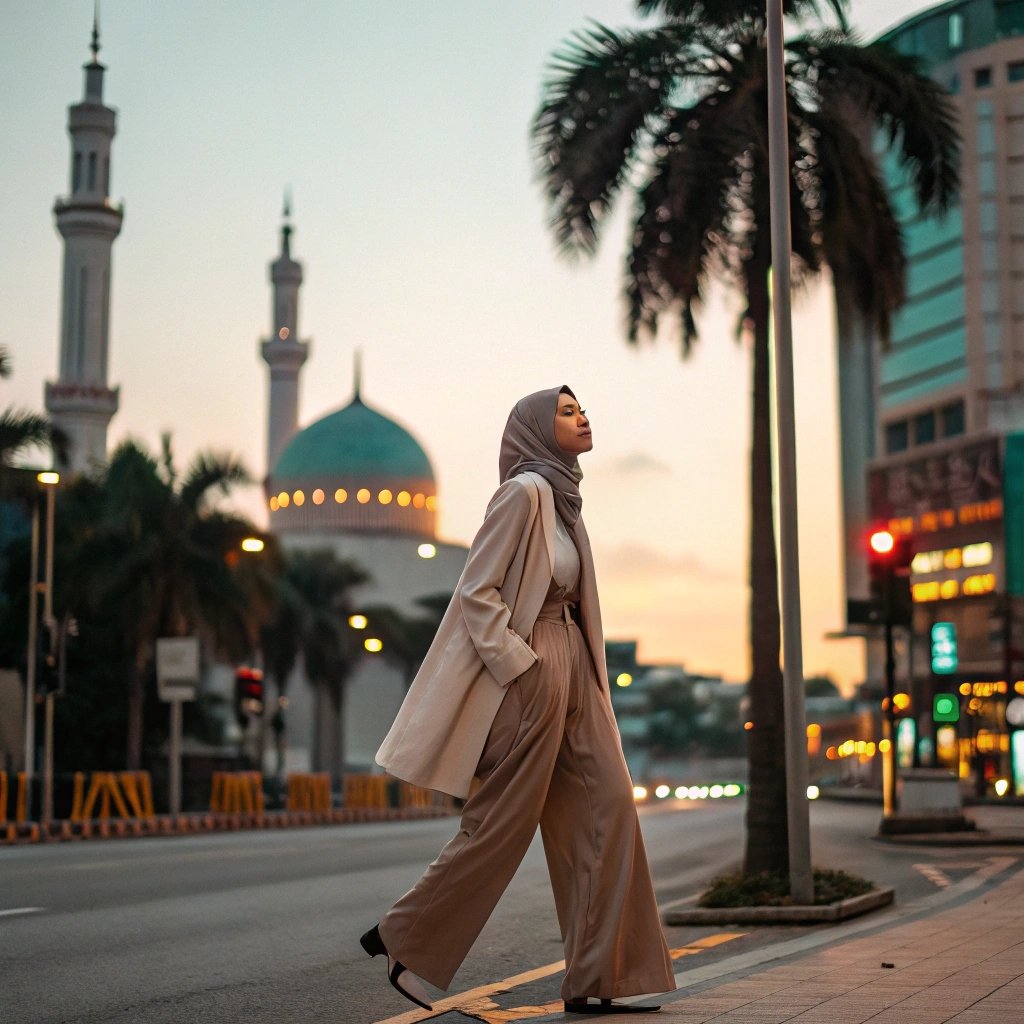
In a studio apartment in Kuala Lumpur, Hana Tajima is draping fabric for her latest Nike collaboration. In Jakarta, the team at KAMI. prepares a limited drop that will sell out within hours. In Singapore, a university student photographs her outfit-of-the-day—oversized blazer, wide-leg trousers, carefully pinned hijab—for the 50,000 followers who watch her navigate modest dressing in tropical heat.
These scenes represent different nodes in the same network: a modest fashion movement that has grown from niche religious requirement into a $300 billion global market, with Southeast Asia increasingly at its creative centre.
The shift isn’t merely commercial. It represents a generational renegotiation of what modesty means, how faith expresses through fabric, and whether covering up and standing out are truly opposites.
The Streetwear Collision
Traditional modest wear and streetwear emerged from opposing impulses. Modesty emphasises coverage, restraint, the subordination of individual display to spiritual principle. Streetwear celebrates visibility, self-expression, the body as billboard for identity and tribe.
The collision between these aesthetics is producing unexpected syntheses.
Consider the abaya—the loose, flowing garment worn across Muslim communities. In its traditional form, the abaya prioritises function over fashion: coverage matters more than cut. Contemporary designers are treating it as a silhouette rather than a uniform. Singapore-based Naelofar produces abayas with architectural pleating that wouldn’t look out of place on a runway. Indonesia’s Ria Miranda layers traditional forms with contemporary streetwear proportions—oversized shoulders, cropped proportions balanced by long underlayers, unexpected colour blocking.
The hijab itself has become a design category. Where once a headscarf was simply a headscarf, young consumers now choose from jersey hijabs for athletic contexts, chiffon for formal occasions, premium modal blends for everyday drape. Brands like Malaysia’s Duck and Indonesia’s Hijup have built empires on this segmentation, understanding that Muslim women want the same product diversity non-Muslim consumers take for granted.
Streetwear’s influence appears in collaborations that would have seemed impossible a decade ago. Hana Tajima’s ongoing Nike partnership produces athletic modest wear—long-line sports hijabs, extended-length tops, leggings with tunic overlays—that performs at the gym while meeting coverage requirements. Uniqlo’s collaboration with the same designer brought modest silhouettes to fast-fashion scale. These partnerships signal mainstream recognition that the modest consumer represents a market worth designing for, not merely accommodating.
The Climate Problem
Modesty requirements become genuinely challenging in Southeast Asia’s climate. When temperatures hover around 32°C and humidity exceeds 80%, layering strategies that work in temperate climates become uncomfortable or impossible.
The response has driven material innovation. Designers prioritise breathable natural fibres—cotton, linen, Tencel—over synthetics that trap heat. Loose, flowing cuts allow air circulation. Strategic opacity replaces layering: a single well-chosen fabric provides coverage without requiring additional layers underneath.
The maxi shirt dress has emerged as a regional signature. Button-through styling allows ventilation adjustment. Belted waists create shape without clinging. The ankle-length hem provides coverage that trouser/top combinations struggle to maintain when sitting or moving. Brands like KAMI. and Lubna have refined this silhouette into countless variations—linen for casual contexts, structured cotton for professional settings, lightweight crepe for evening.
Wide-leg trousers represent another climate adaptation. Traditional slim-cut pants cling uncomfortably in humidity; palazzo silhouettes move with the body while maintaining modesty. Paired with oversized blazers or tunics, they create proportions that read as contemporary streetwear while meeting coverage requirements without heat accumulation.
The styling challenge lies in hijab selection. Traditional heavy fabrics become unbearable. Chiffon hijabs require pins and expertise to maintain coverage without constant adjustment. The instant hijab—pre-sewn to slip on without pins—has gained popularity precisely because it solves the climate-coverage tension, though purists question whether convenience compromises the intentionality of dressing modestly.
Digital Discovery and Community
The mechanisms by which modest fashion spreads have transformed entirely. A decade ago, finding modest clothing required specialised boutiques or international shipping. Today, discovery happens through algorithmically curated Instagram feeds and TikTok hashtags.
The numbers reflect this shift. Searches for modest fashion content have surged across social platforms, driven by young Muslim consumers seeking style inspiration that respects their values. Hashtags like #modestfashion and #hijabstyle aggregate millions of posts, creating visual libraries of outfit ideas that span casual to formal, budget to luxury, conservative to fashion-forward.
Influencers have become tastemakers. Malaysian content creators like Vivy Yusof (who founded FashionValet, now a major modest fashion retailer) built audiences by demonstrating how to style modest pieces as aspirational rather than restrictive. Their content serves dual functions: practical styling guidance and permission-granting for younger viewers navigating family expectations alongside personal expression.
E-commerce has democratised access. Platforms like Modanisa (Turkey-based but shipping globally) and Zalora’s modest sections bring Southeast Asian designers to international consumers and international options to local markets. The friction that once isolated modest fashion has largely dissolved.
Yet digital visibility creates its own tensions. Some observers note that the Instagram aesthetic pushes modest fashion toward performative display—precisely the attention-seeking that modesty principles theoretically discourage. Others argue that visibility normalises modest dress, making it easier for women who choose coverage to do so without constant explanation. The debate reveals that modest fashion isn’t a settled category but an ongoing negotiation.
The Ethical Dimension
Modest fashion brands disproportionately emphasise ethical production—and the pattern isn’t coincidental.
For consumers whose purchasing reflects religious values, the treatment of workers in supply chains carries moral weight. Exploitative labour practices contradict the ethical framework that motivates modest dress in the first place. Brands that articulate this connection—fair wages, transparent sourcing, sustainable materials—resonate with consumers seeking coherence between their values and their wardrobes.
Indonesian brand Suqma exemplifies this positioning. The company works directly with artisan communities, employing traditional textile techniques while paying above-market wages. Marketing emphasises not just the garments but the hands that made them. The consumer proposition isn’t merely “modest clothes” but “modest clothes made modestly.”
Sustainability messaging follows similar logic. Fast fashion’s disposability conflicts with values of intention and restraint. Modest fashion brands increasingly position quality over quantity—fewer, better pieces that last longer. The “capsule wardrobe” concept, popular in sustainable fashion broadly, maps naturally onto modest fashion’s emphasis on considered dressing.
Whether this ethical emphasis reflects genuine values or savvy marketing—or both—the pattern is consistent enough to suggest that modest fashion consumers expect more than coverage from their purchases.
Beyond Restriction
The generational shift in modest fashion reflects a broader renegotiation of what religious practice means for young Southeast Asian Muslims. Previous generations often experienced modesty as externally imposed—family expectation, community surveillance, social pressure. Contemporary practitioners increasingly frame it as chosen expression—a positive statement of identity rather than a concession to restriction.
This reframing matters for fashion. When modesty is restriction, clothing becomes compliance—the minimum necessary to meet requirements. When modesty is expression, clothing becomes creative challenge—how to manifest identity within parameters, how to make constraints productive rather than limiting.
The distinction explains why modest streetwear generates such energy. Streetwear’s DNA is self-expression; modesty’s DNA is self-restraint. The synthesis requires creativity that neither impulse demands alone. The designers and consumers navigating this space are doing genuinely novel work—not simply applying streetwear aesthetics to longer hemlines, but developing new visual languages that say something neither tradition could say separately.
The runway shows, the Instagram feeds, the sold-out drops—these are symptoms of something more significant than trend. They represent a generation deciding for themselves what faith looks like worn on the body. The answers they’re finding are neither purely traditional nor purely contemporary. They’re something new, emerging from a region where 240 million Muslims are growing up with both heritage and hashtags.
That emergence is worth watching—not because modest fashion is a market opportunity, though it is, but because it reveals how identity forms at the intersection of inheritance and invention.

Lina, Founder, Creative Director & Editor-in-Chief
The mind behind Arahkaii. Lina launched the platform to spotlight the designers and brands she kept discovering and thinking “why isn’t anyone talking about this?” She brings a thoughtful, intentional approach to storytelling. She leads the editorial team with a focus on clarity, creative depth, and modern femininity, shaping narratives that feel both elevated and deeply human.She shapes everything from content strategy to editorial tone, is hands-on with every feature, and believes the best content makes you stop scrolling. Currently juggling platform-building, brand outreach, and defending her slow morning ritual as essential creative practice.

