
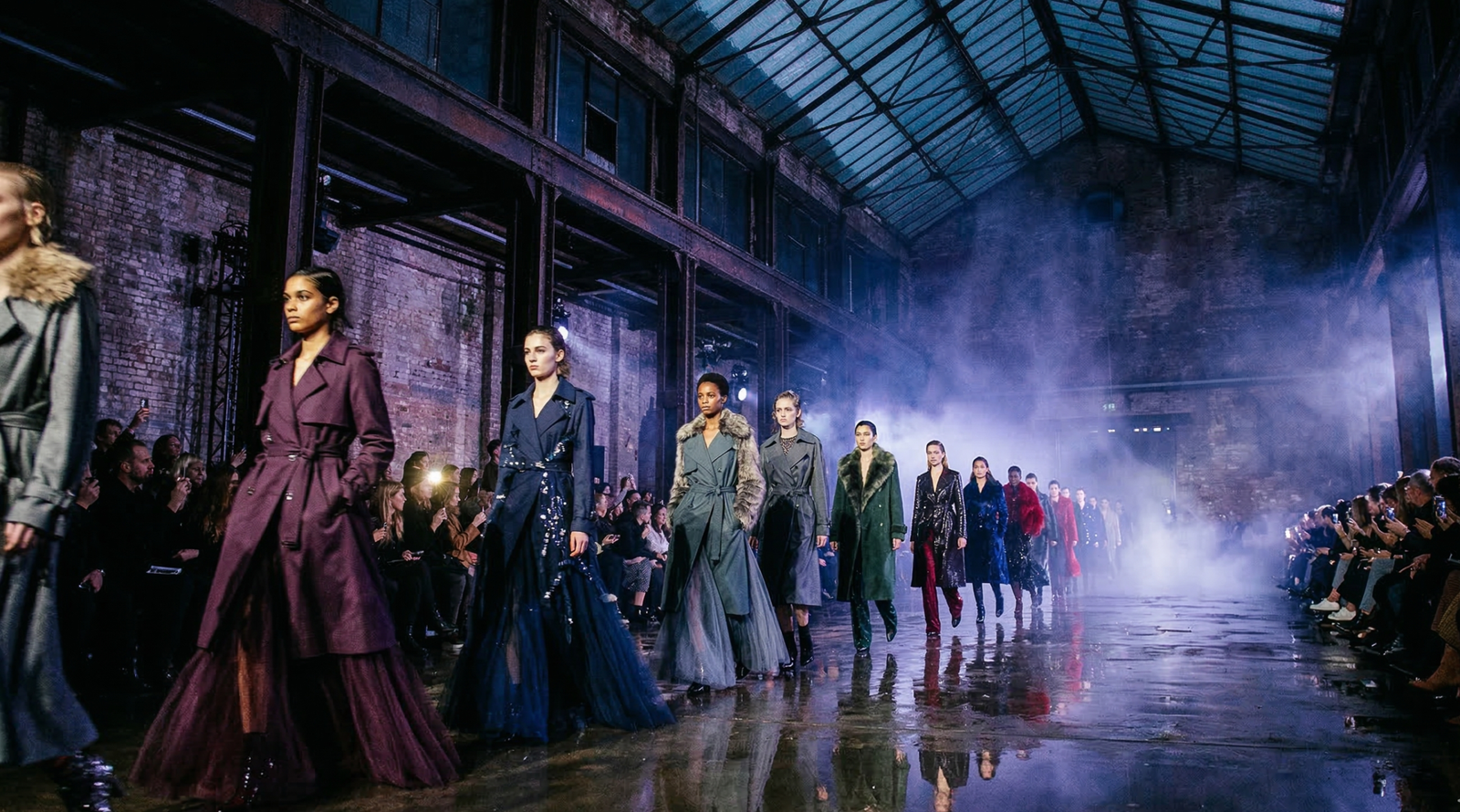
From King Charles in the front row to Simone Rocha’s mythic Adidas collab, LFW delivered dark romanticism, rain-soaked glamour, and the most emotionally charged week on the fashion calendar. Here’s our ranking of the ten shows that earned their place in the conversation.
Let’s be honest: London Fashion Week has always been the unruly middle child of fashion month. It doesn’t have New York’s commercial polish, Milan’s manufacturing muscle, or Paris’s haute couture pedigree. What it has—and what it proved once again across five rain-drenched days from February 19–23—is something none of those cities can replicate: the sheer, chaotic, occasionally unhinged creative energy that comes from a fashion ecosystem built on emerging talent, community, and the stubborn belief that clothes should mean something.
FW26 was defined by dark romanticism, emotional storytelling, and a renewed focus on craftsmanship. Coquette codes and oversized bows recurred across the week. Plaid made a graphic comeback. And the emerging-versus-established tension that makes London unique played out in real time, from the Central Saint Martins MA show to Burberry’s blockbuster finale at Old Billingsgate.
Oh, and the King showed up. Actual King Charles. In the front row. At a show that opened with a Little Simz performance. London is never boring.
Here are the ten shows that stood out, ranked from great to greatest.
10. Chopova Lowena
The Vibe: Regencycore meets mini golf, and somehow it works
Chopova Lowena only shows via runway once a year, which means their February presentations have to carry extra weight. For FW26, they took over the Crafts Council in north London for a presentation that felt more like a playdate than a fashion event. Mannequins posed with their hands up like paws, wearing knitted hoods with animal ears. AstroTurf covered the floor. There was mini golf. There were cupcakes. And the clothes—bodice knits, romantic frills, plaid dresses, argyle skirts, faux fur everything—were softer and cuter than anything they’ve done before. They also quietly launched a subsidiary line, Chopova Lowena Feelings. In a season heavy on dark drama and emotional weight, their commitment to joy felt like a statement in itself.
9. Chet Lo
The Vibe: Hong Kong night markets in a ballroom where the Queen learned to dance
Chet Lo recreated a Hong Kong night market inside the Mandarin Oriental hotel’s ballroom—the same room where Queen Elizabeth reportedly learned to dance. That juxtaposition tells you everything about Lo’s sensibility: cheeky, culturally layered, and completely uninterested in doing what’s expected. The stalls showcased work from ten emerging Asian artists, with proceeds going to the Asian People’s Disability Alliance. The collection itself was compact—just 13 looks—but each one was refined. Eveningwear gowns drew from Peking opera and Wong Kar-wai’s cinematic universe: moody, textural, unapologetically Southeast Asian in its references. For an arahkaii audience, this is exactly the kind of designer who deserves your attention.
8. Emilia Wickstead
The Vibe: For ladies who lunch and get things done
Emilia Wickstead has perfected refined, polished wardrobing—and for FW26, her woman had somewhere to be. Knee-length kilts were reworked with thigh-high slits. A traditional tweed shift dress was styled over an undone denim shirt. Everything was finished with knee-length socks and heavy-duty brogues, grounding the femininity with something tougher. The eveningwear leaned into volume and colour: liquid metal brocade, voluminous trains, the kind of dresses that command a room without raising their voice. Wickstead doesn’t chase headlines, but her consistency in making sophisticated, modern women’s clothing is a quiet form of excellence that London’s fashion ecosystem desperately needs.
7. Richard Quinn
The Vibe: Couture fantasy in a season that didn’t ask for it
Richard Quinn has never met a dramatic silhouette he didn’t love, and FW26 was no exception. Presented at Sinfonia Smith Square, the collection centred on sculpted hourglass shapes: corseted lace bodices spilling into taffeta skirts, diamanté medallions, embroidered bustiers atop satin columns. A finale in imperial purple, red, and turquoise cut through an otherwise monochrome palette. In a season where most of London leaned practical and layered, Quinn’s unapologetic commitment to glamour felt deliberately contrarian. Was every piece wearable? Absolutely not. Was it the kind of show that reminds you fashion is supposed to make you feel something? Yes.
6. Edeline Lee
The Vibe: Fifteen years of making women feel like the best version of themselves
Edeline Lee doesn’t generate the same social media hysteria as some of her London peers, and that’s precisely the point. Her FW26 collection celebrated fifteen years of her label with the kind of quiet authority that only comes from knowing exactly who your woman is. Soft tailoring, flattering pleats, full skirts, and a considered palette of burnt orange, deep blues, and cream—all her signature calling cards, executed with the refinement of someone who has spent a decade and a half perfecting them. But there were party pieces too: a glittering gold gown destined for awards season red carpets, and a caged skirt that nodded to spring’s Circus silhouette trend. No gimmicks, no slogans, no novelty—just beautifully made clothes designed to last a lifetime. In a week dominated by spectacle and high-concept storytelling, Lee’s collection was a reminder that conscious, considered luxury doesn’t need to shout to be heard.
5. Tolu Coker
The Vibe: King Charles, Little Simz, and the most politically charged opening of fashion month
When King Charles III sat down in the front row at Tolu Coker’s opening show—between Stella McCartney and Martine Rose, with Skepta and Little Simz a few seats down—it became the most talked-about moment of the entire week before a single garment hit the runway. Then the show started. Little Simz performed live. Models walked in corseted tailoring and tartans set against a Yoruba colour language: tomato reds, lime yellows, graphic checks. Every look was finished with Manolo Blahniks. Sustainability wasn’t a slogan—British wool, upcycled leather, and reclaimed satin formed the structural backbone. Titled Survivor’s Remorse, the collection channelled Coker’s personal journey from public housing to London Fashion Week. It’s the kind of show that makes you understand why London’s fashion week still matters.
4. Erdem
The Vibe: Twenty years of making flowers feel like high art
How do you celebrate two decades of an independent fashion house? If you’re Erdem Moralıoğlu, you take over the Duveen Galleries at Tate Britain, invite Helen Mirren, Keira Knightley, and Glenn Close to the front row, and deliver a collection that functions as both retrospective and evolution. Fringed tinsel gowns, floral brocades, sheer lace, feathered skirts—familiar signatures were reworked with new restraint. There were feathers poking from the hems of jeans, which shouldn’t work but absolutely did. Buyer after buyer singled out Erdem as the show that best met the moment: a celebration of heritage that felt like a statement of continued relevance. In a fashion industry that increasingly favours corporate revolving doors, Erdem’s twenty years of independent creative consistency is a quietly radical achievement.
3. Simone Rocha
The Vibe: Irish mythology, Adidas bombers, and the most emotionally resonant show of the week
Simone Rocha transformed Alexandra Palace Theatre into a passage to Tír na nÓg—the mythical land of eternal youth in Irish folklore—and delivered the show that every editor was texting about within hours. Drawing on Celtic symbolism, Perry Ogden’s Pony Kids photography, and the legacy of Elizabeth and Lily Yeats, Rocha collapsed romance and utility into the same breath: deconstructed tulle dresses sat alongside tweed tailoring, rosettes punctuated athletic silhouettes, and the Adidas collaboration—pearl-studded track jackets, embellished sneakers, bombers that Paloma Elsesser and Alexa Chung were already wearing in the front row—was the week’s most commercially savvy moment. Earth-toned palettes with flashes of blood red anchored everything to the body. Rocha’s gift is making myth feel lived-in rather than costumed, and FW26 was that ability at full power.
2. Toga Archives
The Vibe: Japanese precision meets London sequins—minimalism that knows how to party
Yasuko Furuta’s Toga Archives is one of those brands that fashion insiders adore and everyone else is about to discover. For FW26, the Japanese-born, London-based designer delivered what might be her most refined collection yet: sleek tailoring, open shirting, sumptuous silk, leather and denim separates—all unmistakably Toga in their clean architectural lines. But then came the twist. Faux fur and shearling added textural warmth. Stone-like organic molten brooches punctuated lapels. And sequins—not scattered, not subtle, but deliberately woven through the collection’s second half—elevated the whole thing from polished minimalism into something with genuine evening energy. The checked fabrics nodded to the plaid trend that ran across the LFW schedule, but Furuta’s version felt sharper and more restrained than anyone else’s. Toga occupies a rare space: too refined for streetwear, too interesting for quiet luxury, and too precisely made to ignore. In a week dominated by big emotional statements and maximalist storytelling, her collection was a masterclass in saying more with less—and then adding just enough sparkle to make you remember every single look.
1. Burberry
The Vibe: Daniel Lee finally figured out what Burberry sounds like—and it sounds like FKA twigs on a wet London night
There’s a trench coat with a map of London’s streets etched into its leather. Let that image sit for a moment.
Daniel Lee’s fourth-year FW26 collection for Burberry was the show that closed London Fashion Week, and it was the show that justified the entire week’s existence. Set at Old Billingsgate fish market against a purpose-built miniature Tower Bridge—scaffolding wrapped in Burberry check, resin puddles mimicking wet pavements, deep blue lighting—the set alone earned its place in fashion lore. FKA twigs provided the soundtrack. Kate Moss arrived 45 minutes late and nobody cared.
But beyond the spectacle, the clothes landed. Belted leather trench coats, down-filled parkas, quilted bombers, calf-length shearling—all in rich plums, navy blues, slate greys, and pine greens. The classic Burberry trench reappeared in bordeaux leather, ruffled faille, patchwork shearling, house check, and that extraordinary London-map leather version. Romeo Beckham, Rosie Huntington-Whiteley, and Edie Campbell walked. Barry Keoghan, Daisy Edgar-Jones, and PinkPantheress sat front row.
Lee described the collection’s inspiration as going out “in a particularly London way.” Previous seasons drew on countryside escapism and festival culture. This was the first time his Burberry felt genuinely urban—and genuinely Burberry. The outerwear was masterful. The palette felt like London in February. The show was blessedly light on the beige tartan, letting the design scream while the branding whispered. As one forum commenter put it: “The first collection that truly feels like Daniel Lee.”
After three years of calibration, Lee has found his frequency. And it sounds like the buzz of a city at night.
The Verdict
London Fashion Week FW26 proved—again—that it occupies a space no other fashion capital can touch. It’s the week where King Charles sits next to Skepta. Where Adidas bombers appear on tulle-covered runways. Where a swimming bath becomes a fashion venue and a 170-year-old heritage house reimagines Tower Bridge in a fish market.
The season’s emotional tone was distinctly darker and more romantic than New York’s polished pragmatism—fitting for a city that has rained every single day of 2026 so far. But within that darkness, there was warmth, community, and the stubborn creative defiance that makes London fashion’s most fearless proving ground.
Milan and Paris might have the budgets. London has the ideas.
Natalia Amir
Feature Writer, Fashion & Lifestyle
With a passport as storied as her byline, Natalia Amir brings a global lens to luxury fashion and contemporary living. Having contributed to international brands across continents, she possesses that rare ability to translate the pulse of global style into narratives that resonate deeply with Asia’s discerning audience. Her writing is informed by years immersed in the luxury market—understanding not just what’s covetable, but why it matters. At Arahkaii, she leads our fashion and lifestyle coverage with intelligence, elegance, and an eye for the extraordinary in the everyday.

